
The food system is getting more fragile.
In 1935, 32 million Americans lived on small farms. Today just 3.4 million people run America’s farms. Fewer farmers, bigger operations and longer supply chains mean less nutritious food, fewer dollars in local economies, and less knowledge transfer on how to grow food well.
1935–1989: Americans living on farms, USDA and Census Bureau. 2022: farm producers, USDA Census of Agriculture.
U.S. farmers started in the last ten years
acres of farmland will change hands in the coming decades
farmers over 65 for every farmer under 35
of U.S. beef is processed by just four companies
The full case.Click here to learn more +
I Fewer people grow our food.
89%fewer Americans on farms+In 1935, 32 million Americans lived on farms, about one in four of us. Today 3.4 million people run all of America’s farms. USDA; Census Bureau; 2022 Census of Agriculture
Every farm that disappears takes a family’s know-how with it: which field floods, when to plant, how to bring animals through a hard winter. For every farmer under 35, there are now four over 65, and much of that knowledge is about to retire. USDA, 2022 Census
II Our food supply is consolidating into a few corporations.
85%of beef, four companies+Four meatpackers now process 85% of the nation’s beef, up from about a third in 1980. USDA ERS
When a handful of plants handle most of the meat, one outbreak ripples everywhere. In April 2020, twelve plant shutdowns idled a quarter of U.S. pork processing. Farmers euthanized animals they couldn’t sell while grocery shelves sat empty. Bloomberg, 2021
The midsize family farms that once fed their regions are being squeezed out. They worked 57% of U.S. cropland in 1987 and 33% by 2017. USDA ERS
III Small farms grow healthier food.
$4.1Tyearly U.S. health costs, driven by chronic disease+Vegetables have lost measurable protein, calcium, iron and vitamin C since 1950, as crops were bred for yield and shelf life. Davis et al., 2004
Grown in living soil, with cover crops, rotations and animals on the land, the same crops carry more magnesium, calcium, potassium, zinc and vitamins than conventional fields next door. That’s how most small regenerative farms already work. Montgomery et al., 2022
It matters because poor diets make people sick. Diet-related chronic diseases like heart disease and diabetes are the leading causes of death in the U.S. and a leading driver of the nation’s $4.1 trillion in yearly health care costs. CDC
IV Buy local, and the farm gets paid.
12¢of a grocery dollar reaches the farm+When food moves through processors, distributors and grocery chains, the farm gets about 12 cents of each dollar you spend. Buy straight from a local farmer and most of that dollar stays on the farm, which is what lets a small operation keep going. USDA ERS, 2024
Better farming pays too. Regenerative corn fields grew 29% less grain but earned 78% more profit. And in Bluffton, Georgia, a town of 103 people, White Oak Pastures left commodity cattle in 1995 and went from four employees to about 180. LaCanne & Lundgren, 2018; White Oak Pastures
V The next generation is ready, but under-supported.
1M+new farmers, too little capital+More than a million Americans have started farming in the last ten years, up 11% since 2017. Most start small, on rented or borrowed land. USDA, 2022 Census
What they don’t have is backing. 59% of young farmers say affordable land is very hard to find, and banks rarely lend to an operation without a track record. So farmers who know how to grow more food can’t buy the freezer, fence or cold storage that would let them. National Young Farmers Coalition, 2022
Sources: USDA NASS Census of Agriculture (1935–2022) and ERS (2024); USDA ERS, Amber Waves (2024); American Farmland Trust; Davis, Epp & Riordan (2004); Montgomery et al. (2022); LaCanne & Lundgren (2018); White Oak Pastures; Bloomberg (2021). Farm share: USDA ERS Food Dollar (2024). Chronic disease: CDC. Microloans: USDA (2013); NSAC (2013).
Why First Farmer’s small grants work.
Capital is the wall. USDA built its microloan program in 2013 because beginning farmers were funding their start on credit cards and high-interest personal loans. The average loan came out to about $19,000, about the size of a First Farmer grant.
A walk-in freezer. A chicken coop. A season of feed. Small money, and it doesn’t have to be paid back.
USDA, 2013; National Sustainable Agriculture Coalition, 2013
USDA microloans are a good program: up to $50,000 at a low rate for new and small farms. They’re also loans, so every dollar has to be paid back with interest, and they’re hard to get. You need a business plan, a stack of FSA forms and collateral, and then you wait on a county office. The Farm Service Agency now has no staff in dozens of counties, some farmers have waited months for approval, and during the 2025 government shutdown loan processing stopped.
We made it simple. One short application, one decision date, no repayment.
That means more local food grown sooner, and first-generation farmers spending their time on the work that builds their skills.
USDA FSA, 2024; New York Times, 2026; Iowa State CALT, 2025
Farmers ready to grow.
Any state · Any scale
Owned, leased or handshake land
You didn’t inherit it.
Nobody handed you the land or the customer list. No cap on years farming.
You’re already farming.
Producing and selling food locally, on owned, leased or handshake land.
You know what it’d do.
A coop, freezers, a bigger herd: $X here grows Y more food.
How it works.
One-page agreement. No repayment. No equity. No line-item reports.
Apply for a grant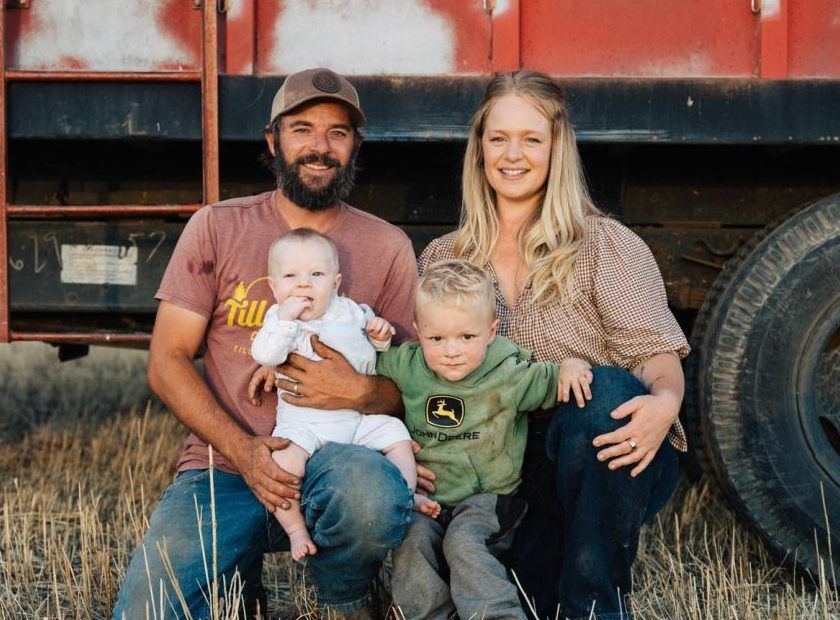
“At a critical time in the summer the condenser in our walk-in freezer unit quit on us. Without local freezer options, our meat operation needed to replace a $10k freezer condenser fast. The funds granted to our farm relieved the financial pressure, on top of all the other pressures that seem to mount mid summer when things are moving fastest.”
Cate · Casad Family Farms, Madras, Oregon
Every dollar goes to farmers.
Our founding funders cover admin costs, so 100% of what you give goes out as grants. Give personally, or fund a grant in your company’s or family’s name.
Tax-deductible through Central Oregon Locavore, a 501(c)(3).
Our backers.
Lineage Provisions and Equip provided capital for fund one and pay every cost of running First Farmer, so every donated dollar goes to a farmer. Central Oregon Locavore is our fiscal sponsor.


